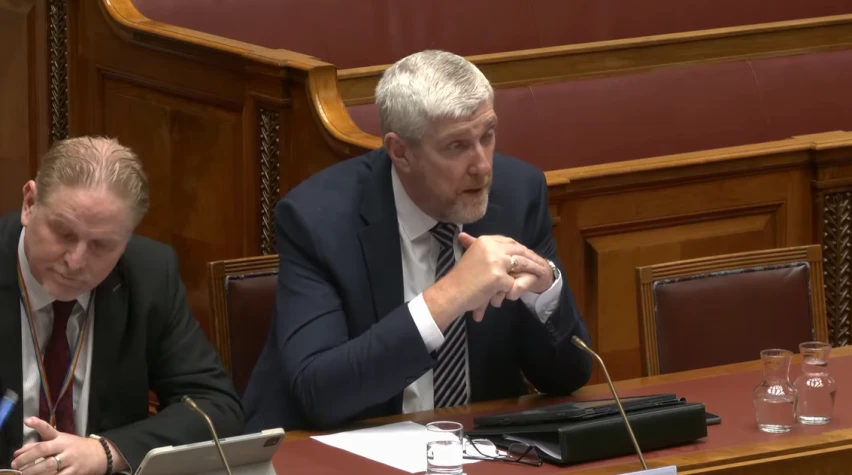




On Wednesday of last week, representatives from four of the five main parties appeared in front of Westminster’s Northern Ireland Affairs Committee to discuss reforms of the Assembly and Executive. The Committee heard the party positions of the SDLP, Alliance party, UUP and DUP. While Sinn Féin did not attend, the party recently published a paper detailing their own proposals for reform.
Pivotal’s analysis can be found following a summary of each witness’s evidence.
SDLP: Matthew O’Toole MLA
The leader of the Official Opposition at Stormont started by criticising the lack of impact the Programme for Government and legislative programme have on driving ministerial delivery. Mr O’Toole said that the lack of detail and targets in the PfG reinforces other poor behaviours in the Executive, which makes it harder for people to see how government can make a difference here. He argued that the current budget impasse is a “perfect example of dysfunctionality of politics as it is currently structured” and that having an Executive more signed up and committed to tackling shared priorities would foster a culture of negotiation and consensus building. As the Official Opposition in the Assembly, he said they have worked to shift the focus onto delivery against shared priorities, but that it has been difficult.
He said that it is a failure of the structures of government and political leadership that trust is so low and delivery is so poor in Northern Ireland. Having an improved culture and stronger leadership is key to unlocking the potential of structural reforms.
Reforms should be phased in, he said, to avoid “boiling the ocean all at once”. A series of achievable “keyhole surgery” reforms should be prioritised before the next election, before a larger process after to consider other changes.
One such change is equalising the titles of First and deputy First Minister. Mr O’Toole said that the two big parties have a “structural political interest in permanent opposition to one another while being in permanent government with one another”. Having ‘Joint First Ministers’ would remove some of this oppositional mindset.
Another is changing the election of the Speaker to a weighted majority system which would make it harder for the Assembly to collapse, and so reduce the chance of a total absence of local representation. He argued that this can be quickly done through an amendment to the Northern Ireland Act.
He also said the “St Andrews veto” on Executive business should be removed. The election of the Justice Minister via D’Hondt, changes to the ministerial code, and agreeing a PfG before or as the Executive is reformed should also be considered.
Alliance party: Eóin Tennyson MLA
The Alliance MLA said that relationships are “absolutely critical” to the operation of the Executive, but that the two largest parties are using their veto power to “hold the business of government to ransom”. While the institutions were designed to bring opposing sides together post-conflict in the hope that trust would build over time, after 28 years, it was his assessment that there remains no joined-up vision for government here.
The result of this is that the Executive is unable to deliver for citizens here: “if you do not have sustainable public institutions, you cannot build sustainable public services”. The PfG, he said, is presented to smaller Executive parties rather than being written with them, which further harms relationships.
Mr Tennyson discussed the sidelining of parties that designate as ‘Other’ for cross-community votes. He raised the point that for the upcoming Petition of Concern vote on raising the Minimum Age of Criminal Responsibility, the Justice Minister who is responsible for the legislation, cannot have a say as an MLA. He said the Alliance Party would not return to the Executive without a “change in attitude” from the two big parties, to either reform the institutions or start a process towards reform. He said the Belfast/Good Friday Agreement was based on “sufficient consensus” rather than “total consensus”, which should also be the metric for any reform in future.
He pointed to a number of specific changes detailed in the party’s recent “Democratic Renewal” paper. The first was ending the single-party veto, allowing the next largest party of any designation to take the First or deputy First Minister roles if one of the two main parties forgo their place. Some Committee members were concerned about the impact this would have on power-sharing between the two main communities here. Mr Tennyson said there would be protections in place, such as weighted majority votes for budgets.
He also called for weighted majority voting to replace cross-community votes (particularly for the election of the Speaker), restricting the Petition of Concern, and enforcing the three-meeting rule on Executive business.
He called on the Secretary of State to bring the parties together to discuss and move forward on reform.
UUP: Jon Burrows MLA
The UUP leader argued that the system of government was not designed with delivery in mind, rather it was set up to maximise inclusion and bring people together. He argued that insufficient political leadership “failed to evolve” the institutions beyond this, while also recognising the structural issues at play.
His party is in favour of changing the titles of First and deputy First Minister to reduce polarisation in elections, and also to move towards a weighted majority for the election of the Speaker. This would be a step towards “normalising our politics towards normal democratic principles as opposed to a carve-up between communities”. They also support a fully functioning Official Opposition with shadow portfolios.
Mr Burrows said that removing the single-party veto would need properly thought through, as the potential for the First and deputy First Ministers both being from the same community is “unworkable”. However, he did say the UUP is in favour of finding ways to stop the institutions collapsing and reinforcing a joint responsibility for difficult decisions.
On the legislative process, Mr Burrows recommended the creation of Bill Committees to minimise “bad legislation”. He also said that the Assembly focuses too much on non-binding motions. He argued that the Petition of Concern has been “overused and mis-used in the past”, but that his decision to sign a recent petition on raising the Minimum Age of Criminal Responsibility was a legitimate use of a “democratic lever”.
Mr Burrows suggested a “carrot and stick” approach for reform negotiations where the UK Government would allow the Executive to lower corporation tax and pilot a lower VAT rate for hospitality in return for agreement about reform. He also made clear that the UUP do not believe that the Irish Government have a role in reform conversations; as a Strand One issue it is for the parties here and the UK Government to oversee.
DUP: Gavin Robinson MP
The DUP leader discussed the possibility of a “more realistic but agreed sense of a coalition agreement when people enter government”, where work could begin on a PfG before the Executive is formed based on the party manifestoes. MLAs would therefore work from a “complementarity of aspiration”.
He said that the run-up to an election is the wrong time to work on reforms and that any changes must not “undermine the fundamentals” of the Belfast/Good Friday Agreement, such as community protections. Vetoes and blocks come at the end of a process where compromise and negotiation have failed, he argued, and that this could be avoided by a “willingness of people to work together”.
Many of the reforms the other witnesses had mentioned faced opposition from Mr Robinson – particularly moving to ‘Joint First Ministers’ is “fanciful” and changing the election of the Speaker. Using the example of developments being stalled due to the inability to connect to the wastewater network, he said, “’How on earth would a change in the titles of First Minister and Deputy First Minister deliver water infrastructure in Ahoghill?’ It would have absolutely no impact on the ability to change planning or water infrastructure at all.”
The DUP are not against the idea of reform, Robinson argued, but they appear to have concerns about the tone and direction of the conversation at present. This was particularly evident in discussions about cross-community protections. He said there is a strong feeling that these safeguards are being threatened now that the DUP are no longer the largest party in the Assembly and that this, along with an impending election, serves to politicise the debate around reform.
The Executive should focus on delivery. Debates about institutional reform would not “make one jot of difference” to people in Northern Ireland. Mr Robinson clearly stated that “devolution has to deliver for people… it is not doing that currently”.
This, and better functioning institutions, are best achieved through a change in culture. He said, “the greatest reform has to be an attitude and a will, and has to be in the desire for elected representatives and leaders to work together to deliver”. He has been “disappointed with the absence of goodwill” in the Executive so far.
Pivotal’s analysis
1. There was a lot of crossover with Pivotal’s new report, 'Improving the institutions: suggested reforms to the Northern Ireland Assembly and Executive'
Many of the issues discussed across the session were explored in last week’s report, Improving the institutions: suggested reforms to the Northern Ireland Assembly and Executive. Resourcing the Official Opposition, changing the election of the Speaker, Bill Committees, enforcing the three-meeting rule, and the importance of the PfG, Budget and legislative programme were key themes throughout. In the report we consider the opportunities and challenges of each.
There was quite a bit of common ground between the SDLP, UUP and Alliance at the session. The DUP’s focus was much more on cultural change rather than structural reforms, but all parties seem to agree that relationships need to improve.
2. There is agreement that government is not delivering, but not about what to do about it
All the parties present agreed that the Executive is not delivering sufficiently for people in Northern Ireland, even from those represented in the Executive itself. But beyond that, there was no clear common thread between them about how to change this for the better. Alliance and the SDLP are urgently calling for reform of the institutions, the DUP want a change in culture and attitudes, and the UUP are calling for both. Alliance, the SDLP and UUP were all asked whether there was a failure of structures or political leadership which has led to the current issues, and all agreed it was a combination of the two. All four parties were in firm agreement that relationships need to improve.
3. What is meant by the need to achieve consensus about reforms?
The SDLP’s proposals for reform were drafted with getting the support of all the parties in mind. Eóin Tennyson for Alliance said “sufficient” rather than “total consensus” should be the threshold for reform. The UUP leader said “broad consensus” is needed and that it could be possible to bring all the parties along if proposals are designed right, while the DUP leader said there needs to be cross-community support for reform. Some witnesses shared a desire to see some reforms implemented in the short-term with a longer process to iron out the details of other reforms, but it is clear that there is no clear timeline emerging for the reform discussion just yet.
4. The DUP’s position stands out from the others
The other three parties were keen to talk openly about proposals for reforming the institutions, up to and including removing the single-party veto. There was a clear sense of urgency from the SDLP and Alliance particularly. However, while Gavin Robinson repeatedly stated that his party is not against reform, he seemed much less willing to argue the details of any proposals, and called consistently for greater “goodwill” and attitudinal changes over structural ones.
5. Culture, attitudes and behaviours remains key
The evidence session focused on structural reforms, as does the wider reform debate. However, all parties present agreed that relationships need to improve around the Executive table. Without this, delivery will deteriorate. This was also a strong finding from all our experts interviewed for our paper, Improving the institutions. A sense of goodwill, leadership, a willingness to negotiate and a shared drive and determination are needed from ministers.
6. There isn’t agreement how or when discussions about reforms will be taken forward
The Assembly and Executive Review Committee (AERC) is the primary current forum for discussions about reform to take place. However, there was some uncertainty among witnesses as to whether or not it would make a real difference. Those who were more in favour of driving a reform conversation were more sceptical. Jon Burrows said it “isn’t going to achieve” many reforms and that the party leaders need to come together to find a way forward, while Eóin Tennyson said the Committee risks becoming a “talking shop”. Gavin Robinson, however, repeatedly said he believes the AERC is the correct space for these conversations to be had.